📬 GYN Oncology Intelligence Digest — Week 2026-W44
ESMO 2026 dominates GYN this week: DUO-E interim OS shows a median 51.1 months with durvalumab plus olaparib, NRG-GY020 adjuvant pembrolizumab is negative in early dMMR endometrial cancer, RAINFOL-02 reports PFS HR 0.29 and OS HR 0.43 for rinatabart sesutecan in platinum-resistant ovarian cancer, and a new LGSOC expert consensus plus a carboplatin/mirvetuximab phase 2 land in print.
⚡ TL;DR
📄 Publications
- Low-grade serous ovarian cancer: 2026 expert consensus report. — The 2026 consensus incorporates NRG-GY019 data supporting chemotherapy-containing postoperative therapy as the reference approach for stage II-IV LGSOC, with endocrine monotherapy as selected de-escalation
- Carboplatin Plus Mirvetuximab Soravtansine In Platinum-Sensitive Ovarian Cancer: A Phase 2 Nonrandomized Clinical Trial. — Single-arm phase 2 enrolled 125 patients with recurrent FRα-expressing platinum-sensitive ovarian cancer (102 FRα ≥50%; 61 prior PARPi) receiving carboplatin AUC 5 plus mirvetuximab 6 mg/kg AIBW Q3W
🐦 Twitter / 🦋 Bluesky
- TroFuse-005 brings sac-TMT to previously treated endometrial cancer at the ESMO Presidential Symposium — TroFuse-005 (LBA11) tests sacituzumab tirumotecan versus physician's choice in recurrent/advanced endometrial cancer
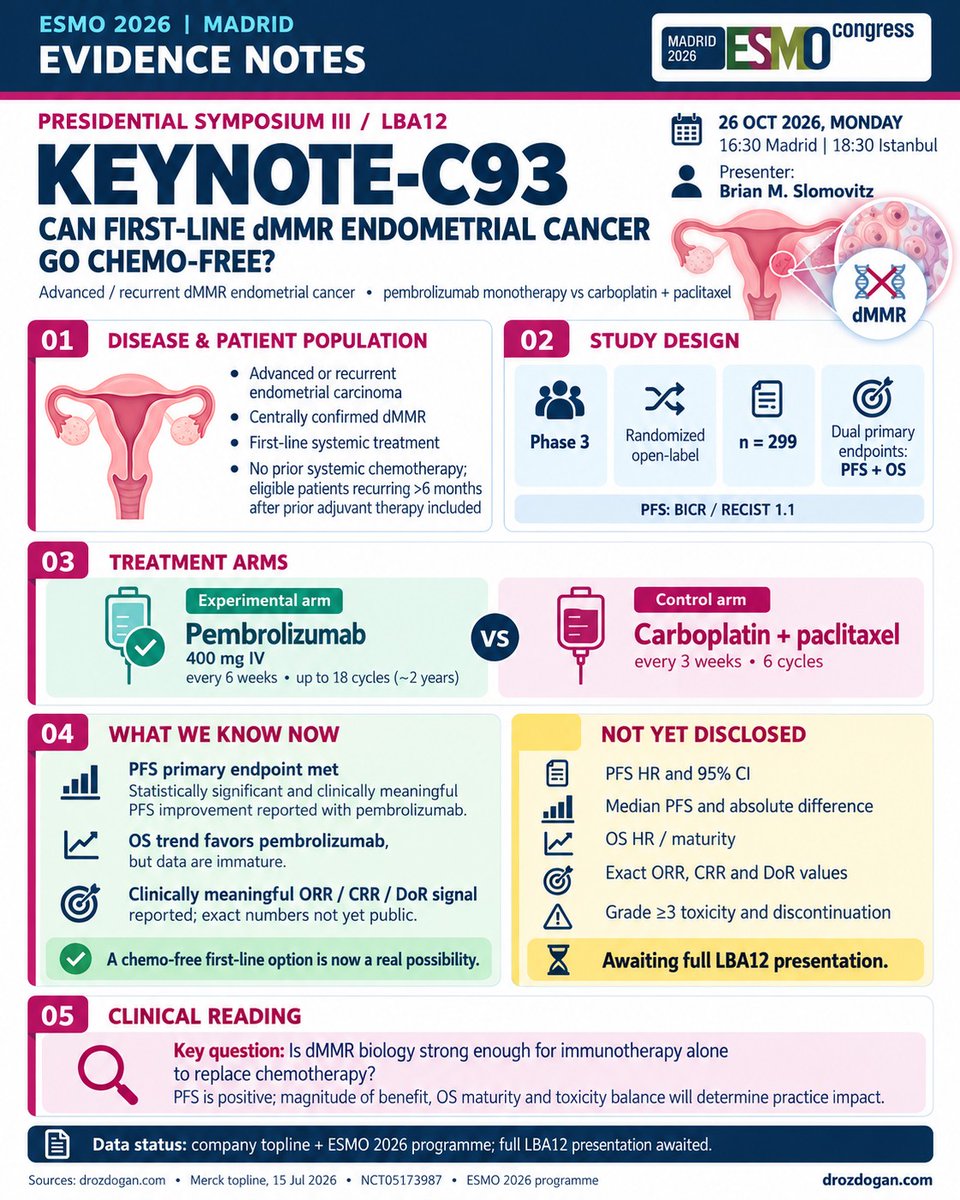
- KEYNOTE-C93 asks whether dMMR endometrial cancer can skip chemotherapy in the first line — KEYNOTE-C93 reported that pembrolizumab monotherapy improved PFS versus carboplatin-paclitaxel with still-immature OS
- DUO-E interim OS at ESMO 2026: 51.1-month median with durvalumab plus olaparib, but the survival benefit is concentrated in dMMR — Durvalumab plus chemotherapy followed by durvalumab and olaparib reached a median overall survival of 51.1 months, 11.5 months longer than chemotherapy alone
- Payload before target: FRα and B7-H4 ADC data push the field to sequence by payload biology, not antigen density — Torvutatug samrotecan produced ORR 48% in FRα ultralow/null, 57% low and 62% high with overlapping confidence intervals, and 47% ctDNA complete molecular response with no clean link to FRα
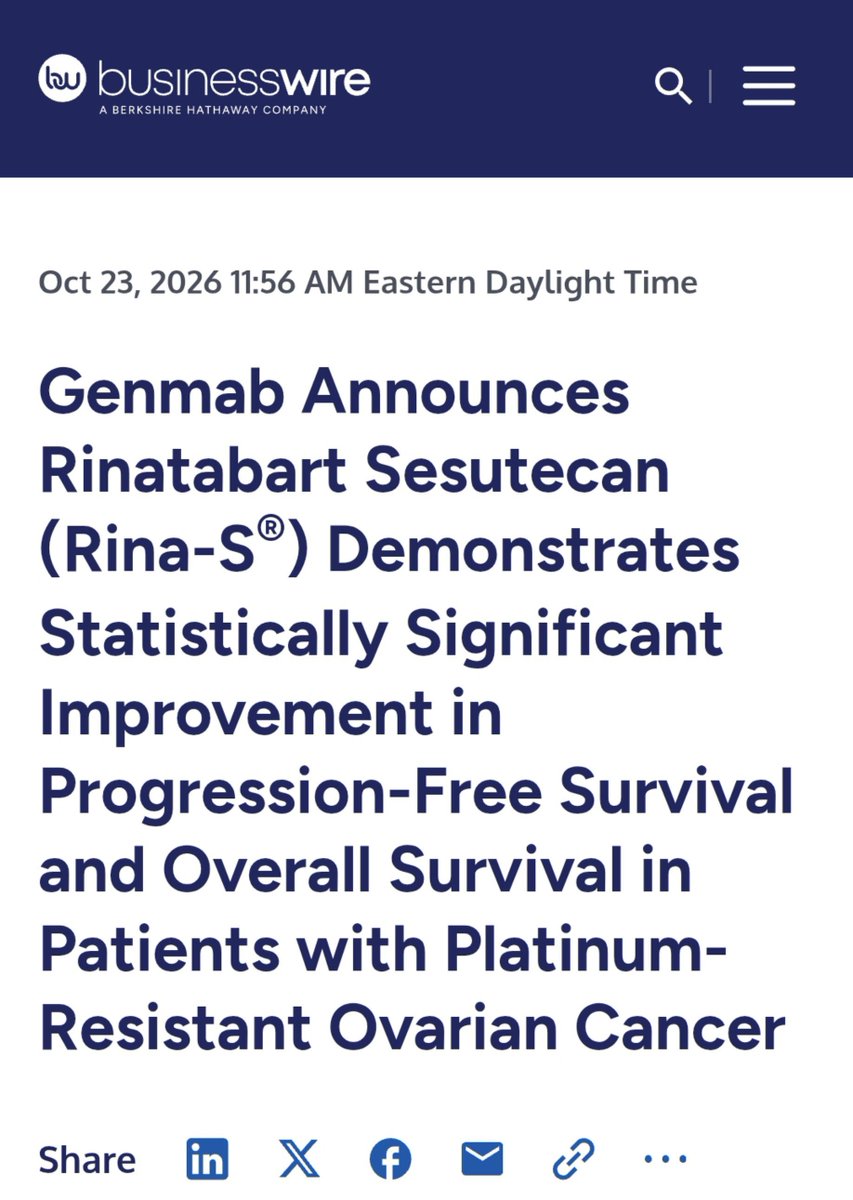
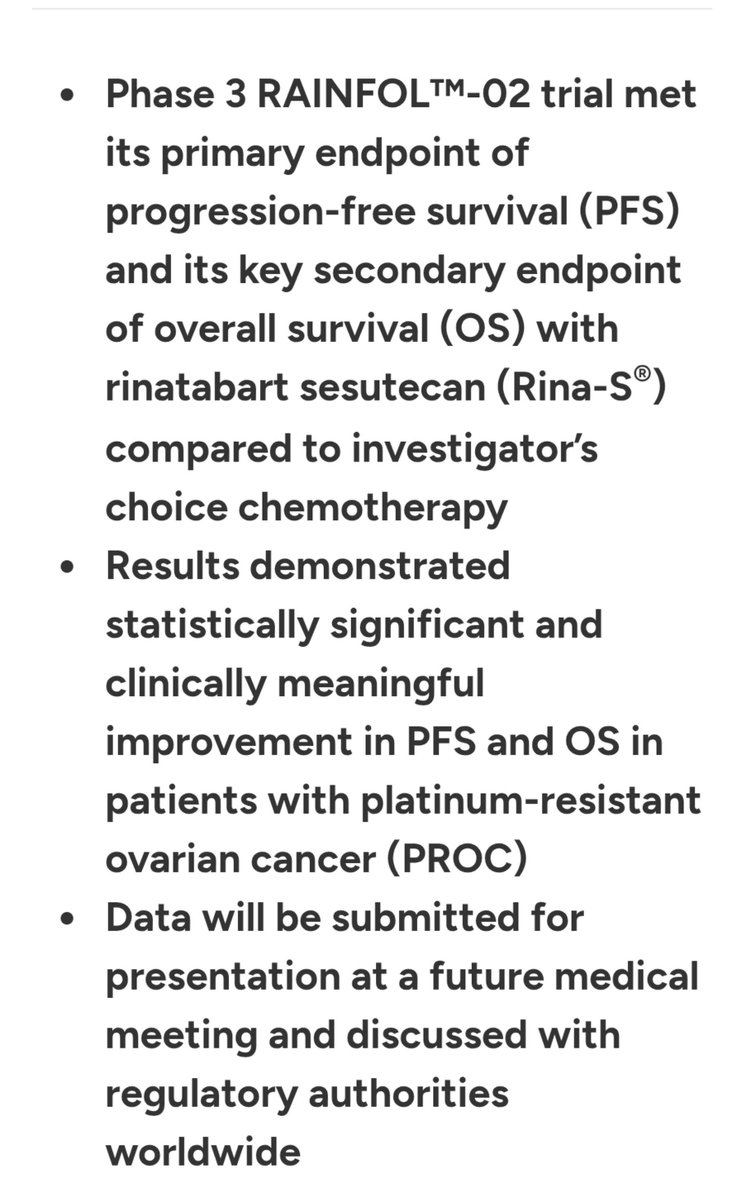
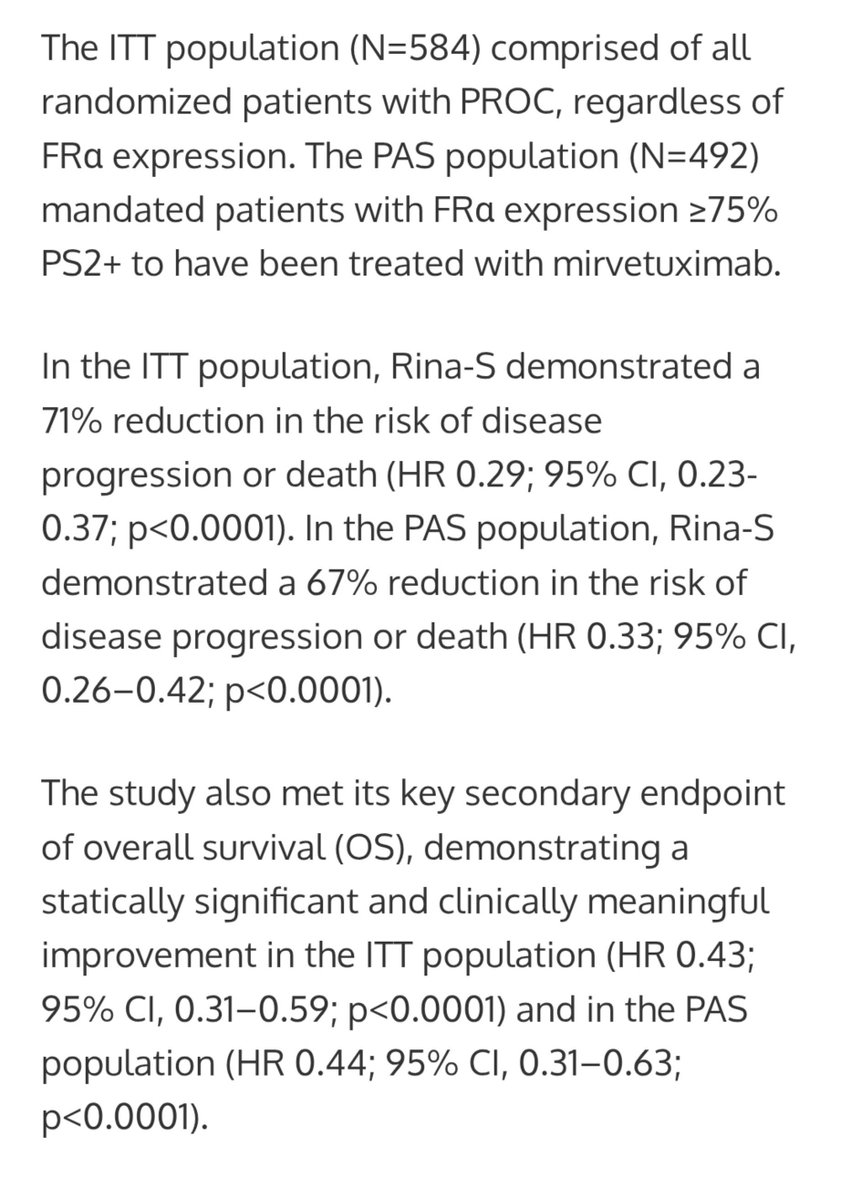
- RAINFOL-02 topline: rinatabart sesutecan improves PFS and OS in platinum-resistant ovarian cancer without FRα selection — Phase 3 RAINFOL-02 reported PFS HR 0.29 (95% CI 0.23–0.37) in the ITT and HR 0.33 (95% CI 0.26–0.42) in the primary analysis set, with OS HR 0.43 (95% CI 0.31–0.59) ITT and 0.44 (95% CI 0.31–0.63) in the primary analysis set, all p<0.0001
Full details below ↓
📄 What's Being Published
Low-grade serous ovarian cancer: 2026 expert consensus report. — Grisham Rachel N et al., Gynecol Oncol
The updated consensus incorporates NRG-GY019 data supporting chemotherapy-containing postoperative therapy as the current reference approach for stage II-IV LGSOC. It recognizes selected circumstances in which endocrine monotherapy may represent individualized de-escalation. For recurrent disease, it integrates the US Food and Drug Administration's accelerated approval of avutometinib in combination with defactinib for KRAS-mutated LGSOC and emerging evidence for endocrine therapy combined with CDK4/6 inhibition. The panel also emphasizes treatment-specific biomarker interpretation, multidisciplinary care and central pathology review for clinical trials.
Clinical bottom line: Chemotherapy-containing postoperative therapy is the reference for stage II-IV low-grade serous ovarian cancer. Endocrine monotherapy is a legitimate option for selected patients. At recurrence, the consensus supports biomarker-directed avutometinib/defactinib or endocrine therapy plus CDK4/6 inhibition.
Carboplatin Plus Mirvetuximab Soravtansine In Platinum-Sensitive Ovarian Cancer: A Phase 2 Nonrandomized Clinical Trial. — Konecny Gottfried E et al., Clin Cancer Res
The trial enrolled 125 patients (102 FRα ≥50%; 61 prior PARPi). ORR by end of 6 combination cycles was 62.7% (95% CI, 52.6-72.1) in the FRα ≥50% group and 62.4% (95% CI, 53.3-70.9) overall. In patients with FRα ≥25%, median duration of response was 11.2 months (95% CI, 8.5-13.6) and median PFS was 11.0 months (95% CI, 9.8-13.1). Blurred vision (81%) and corneal events (74%) were the most common adverse events, and 96.7% of corneal cases resolved or had final grade 1. Adjudicated treatment-related pneumonitis occurred in 19 (15.2%) patients, including 2 fatal cases.
Clinical bottom line: In FRα-expressing platinum-sensitive recurrence, carboplatin plus mirvetuximab gives a response rate of roughly 62%, including after PARP inhibitor exposure. However, the 15.2% pneumonitis rate, with two fatal cases, keeps this a trial regimen until randomized data are available. It is not a new platinum-sensitive standard.
🗂 Every paper considered this week, including the ones that didn’t make it →
🗣️ What People Were Discussing This Week
How these are chosen: filtered for clinical relevance, grouped by the new development discussed, then ordered by engagement (bookmarks and reposts).
TroFuse-005 brings sac-TMT to previously treated endometrial cancer at the ESMO Presidential Symposium
TroFuse-005 (LBA11) tests sacituzumab tirumotecan against physician's choice in previously treated recurrent/advanced endometrial cancer and was presented in the ESMO 2026 Presidential Symposium. The posts were previews and discussion only, with no efficacy or safety results reported. A related abstract (1259P) tests sac-TMT plus pembrolizumab in post-platinum pMMR disease. Because TROP2 is expressed in most endometrial tumors, one clinician argued that if sac-TMT works, the target was never the hard part. The open question is which non-TOP1 mechanism would remain for the next line if sac-TMT becomes standard after platinum and immunotherapy.
Discussed by: @JaniceTNBCmets, @OncBrothers, @OncoAlert
KEYNOTE-C93 asks whether dMMR endometrial cancer can skip chemotherapy in the first line
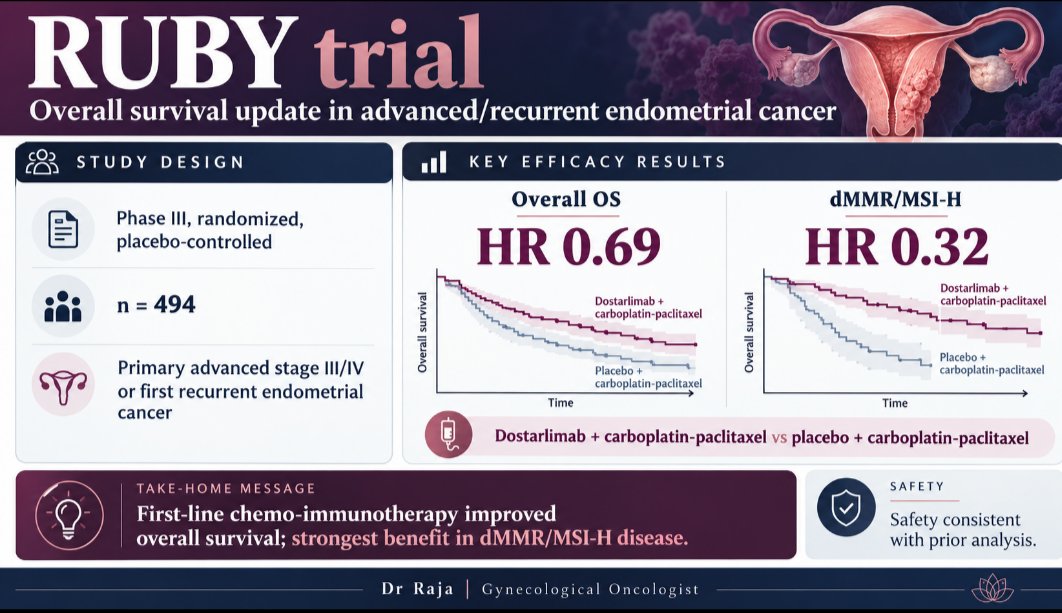
KEYNOTE-C93 (LBA12) reported that pembrolizumab monotherapy improved PFS versus carboplatin–paclitaxel in first-line dMMR disease. OS is still immature, and the magnitude of benefit, toxicity data and PFS numbers have not yet been reported. Clinicians noted the conundrum this creates for active trials that require platinum as standard, and asked whether chemotherapy can simply be added back later. The debate centers on whether a PFS win is enough to drop platinum before OS matures. The comparator is RUBY, where dostarlimab plus carboplatin/paclitaxel in 494 patients showed an OS HR of 0.69 overall and 0.32 in the dMMR/MSI-H subgroup.
Discussed by: @ozdogan_md, @MAvilaMD, @G_Raja__
Sources cited: OncoDaily
DUO-E interim OS at ESMO 2026: 51.1-month median with durvalumab plus olaparib, but the survival benefit is concentrated in dMMR
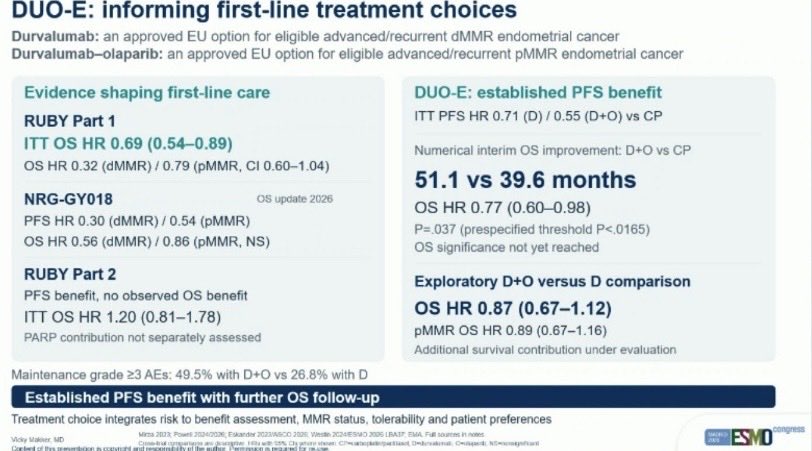
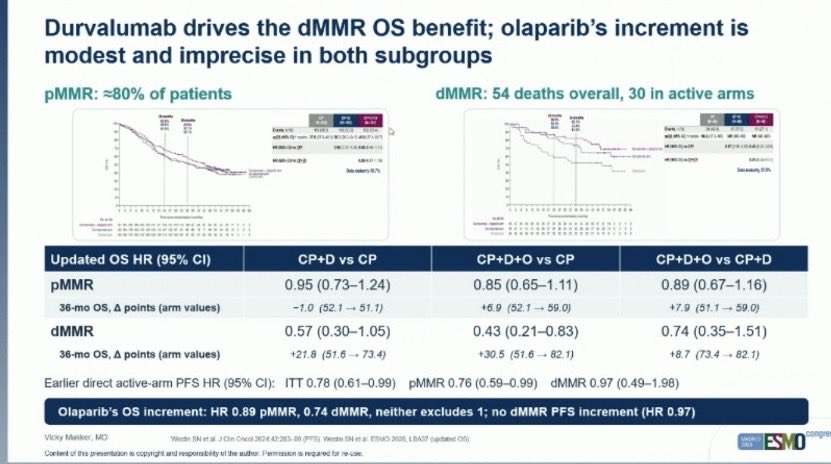
In this three-arm first-line phase 3 trial, durvalumab plus chemotherapy followed by durvalumab and olaparib extended median overall survival compared with chemotherapy alone. By MMR status, durvalumab drives the benefit in dMMR tumors and olaparib adds nothing there. In pMMR disease, olaparib adds a modest PFS gain with no survival benefit shown, and grade ≥3 toxicity roughly doubles. Olaparib was never formally tested against durvalumab alone, so that comparison is exploratory. Some clinicians read the trial as negative for OS and would restrict the approach to dMMR patients, while others advise reading the olaparib effect within the pMMR group.
Key numbers: Median OS 51.1 mo, 11.5 mo longer than chemo alone · dMMR OS HR 0.57 · dMMR olaparib PFS HR 0.97 · pMMR olaparib PFS HR 0.76 · pMMR grade ≥3 AEs 26.8% → 49.5%
Discussed by: @phsiao4, @DrBarbiOnc, @SuyogCancer, @Dr_Oncologista, @MeDucationai, @OncBrothers
Payload before target: FRα and B7-H4 ADC data push the field to sequence by payload biology, not antigen density
Torvutatug samrotecan, an FRα ADC with a TOPO1 payload, produced responses across FRα levels with overlapping confidence intervals, and ctDNA complete molecular response showed no clean link to FRα. Rinatabart sesutecan likewise showed efficacy regardless of FRα status in heavily pretreated platinum-resistant ovarian cancer. These data are exploratory and single-arm. One clinician framed the ADC question as which payload and in what order rather than which target, since once a TOPO1 ADC is standard in PROC, every later TOPO1 ADC is a payload rechallenge. B7-H4 ADC discussion at ESMO covered testing, toxicity in maintenance use, and sequencing amid resistance and target shifts. The open questions are whether trials should stratify by payload-pathway biology rather than antigen immunohistochemistry, and whether prior TOP1 ADC exposure disqualifies the next one.
Key numbers: Torvutatug ORR 48% ultralow/null · 57% FRα low · 62% FRα high · ctDNA complete molecular response 47%
Discussed by: @DrBarbiOnc, @JaniceTNBCmets, @ShannonWestin
Sources cited: Business Wire press release · Targeted Oncology · Targeted Oncology
RAINFOL-02 topline: rinatabart sesutecan improves PFS and OS in platinum-resistant ovarian cancer without FRα selection
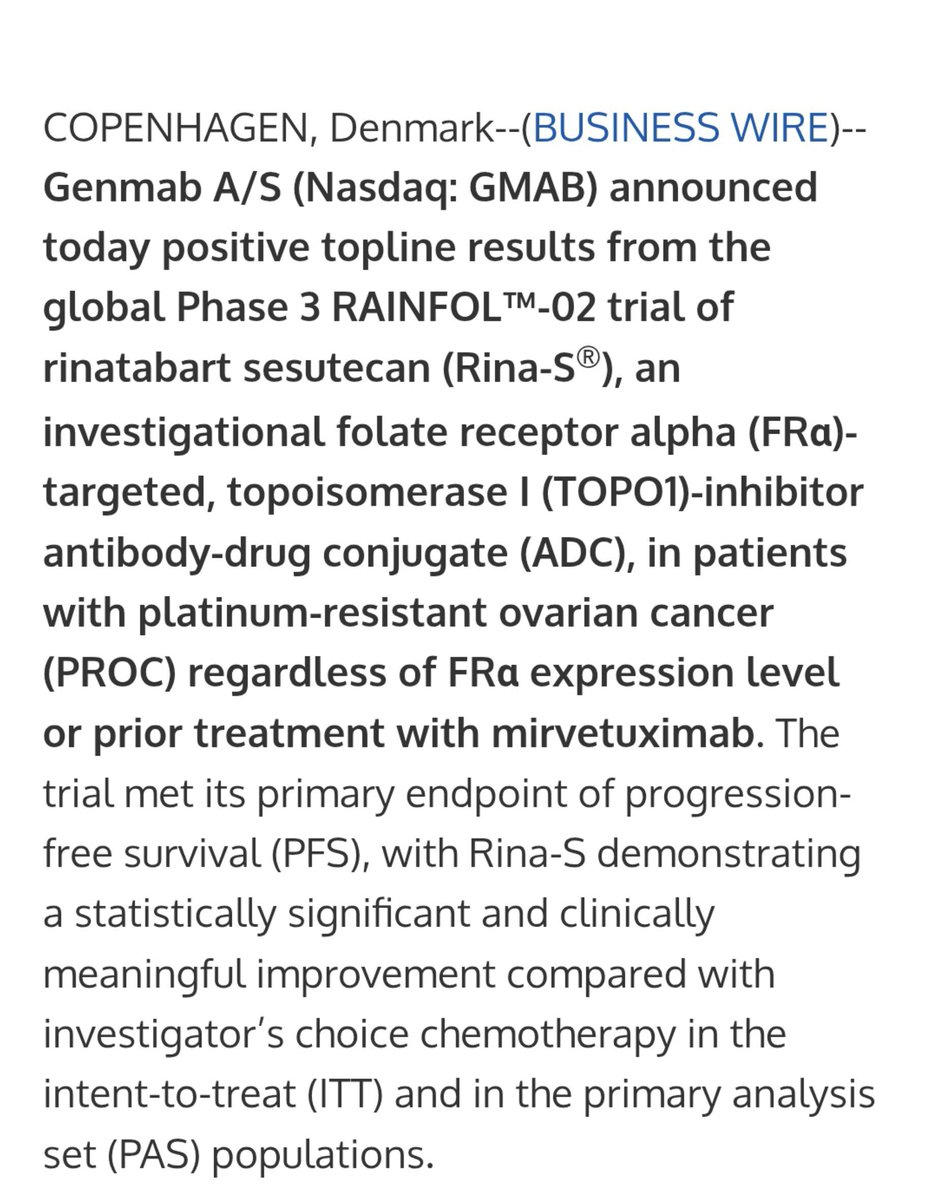
Phase 3 RAINFOL-02 compared rina-S with chemotherapy and showed PFS and OS benefits in both the ITT population, enrolled irrespective of FRα expression, and the primary analysis set of FRα-high, post-mirvetuximab patients. Only topline press-release data are available, with no medians yet. Prior context includes AURELIA, which improved PFS with bevacizumab but not OS, and MIRASOL, the first phase 3 OS benefit, seen only in FRα-high disease. If the FDA label follows the ITT population, FRα IHC stops being the gate for an ADC in PROC. For FRα-high patients, the debate is whether mirvetuximab (DM4) should still precede rina-S (TOPO1), or whether the reverse order is now preferred.
Key numbers: PFS ITT HR 0.29 (95% CI 0.23–0.37) · PFS primary set HR 0.33 (95% CI 0.26–0.42) · OS ITT HR 0.43 (95% CI 0.31–0.59) · OS primary set HR 0.44 (95% CI 0.31–0.63) · all p<0.0001
Discussed by: @SuyogCancer, @DrBarbiOnc
Sources cited: Business Wire press release
BEHOLD-1 B7-H4 ADC mocertatug rezetecan: 62% response in platinum-resistant ovarian cancer and responses at every B7-H4 level
Mocertatug rezetecan, formerly HS-20089, is a B7-H4–targeted ADC with a TOPO1 payload, developed globally by GSK through a licensing agreement with Hansoh Pharma. In phase I BEHOLD-1 it showed early activity in platinum-resistant ovarian cancer and advanced endometrial cancer at higher doses. Responses occurred at every B7-H4 level and tracked with cathepsin B and TOP1. These biomarker findings are exploratory and come from a single-arm study. The question is whether phase 3 trials should select patients by target immunohistochemistry at all, or by payload-pathway markers such as cathepsin B and TOP1.
Key numbers: PROC confirmed ORR 62% at 5.8 mg/kg · median DoR 12.2 mo · endometrial response rate 67%
Discussed by: @DrBarbiOnc, @phsiao4, @StephanieLheur5
Sources cited: The ASCO Post · OncLive
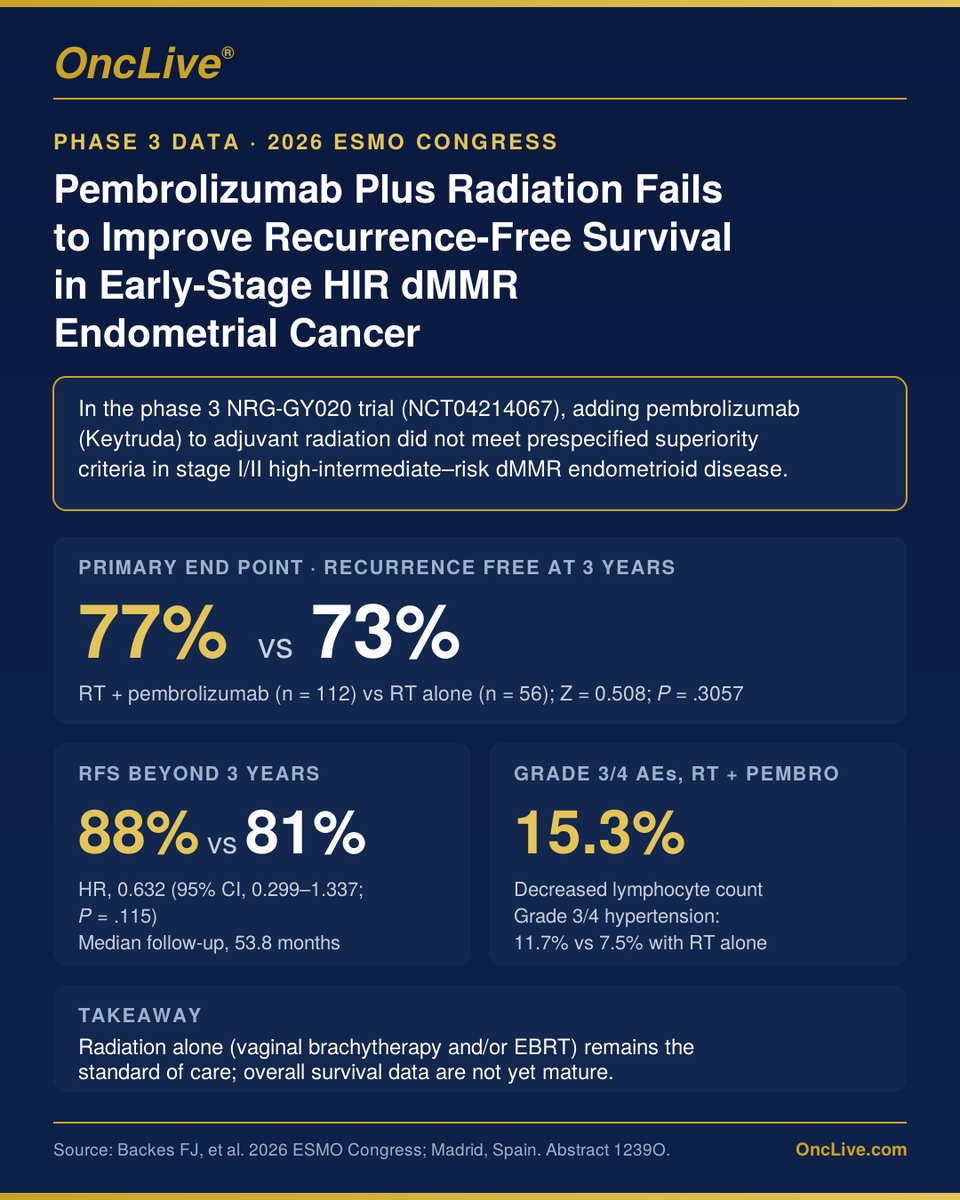
NRG-GY020: adding pembrolizumab to adjuvant radiation fails in early-stage high-intermediate-risk dMMR endometrial cancer
In newly diagnosed stage I to II endometrioid, high-intermediate-risk dMMR endometrial cancer, adding pembrolizumab to adjuvant radiation did not improve 3-year RFS. OS was unchanged and toxicity rose substantially. One discussant concluded that after surgery, pembrolizumab helps where risk is high and adds little where cure is already likely. On selection, postoperative ctDNA would flag only about 1 in 10 patients in a GY020-type population, so more sensitive assays and testing beyond 2-3 years would be needed. The debate is whether radiation alone is now settled, or whether a ctDNA- or risk-defined subgroup merits re-testing with immunotherapy.
Key numbers: 3-year RFS 70% vs 73% (P=0.68) · 3-year OS 96% in both arms · Grade 3–4 toxicity 43% vs 15% · 21% stopped pembro for toxicity
Discussed by: @DrBarbiOnc, @DrKatyMoore, @OncoDailyRT
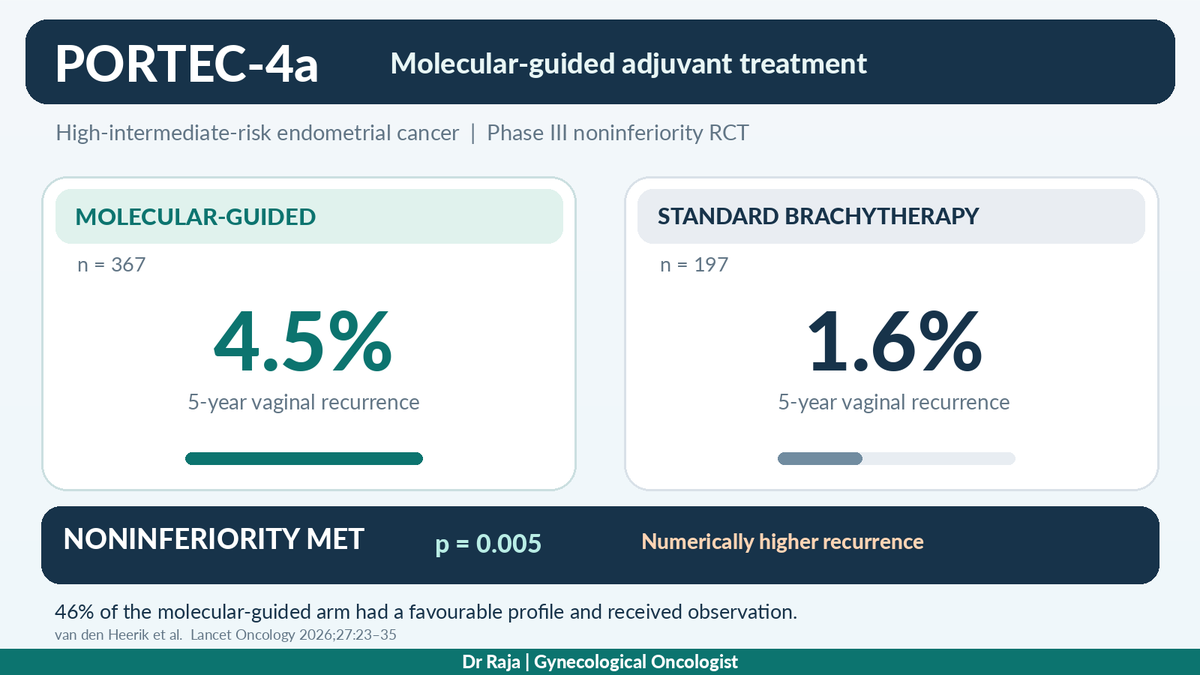
PORTEC-4a: molecular-guided adjuvant therapy meets noninferiority for 5-year vaginal recurrence in high-intermediate-risk endometrial cancer
PORTEC-4a enrolled 564 patients. Molecular-guided adjuvant care for high-intermediate-risk endometrial cancer met noninferiority against vaginal brachytherapy for 5-year vaginal recurrence (4.5% vs 1.6%; p=0.005), although rates were numerically higher in the molecular-guided arm. Separately, clinicians are adopting radiation alone for early-stage dMMR disease. The trade-off is whether a 4.5% versus 1.6% vaginal recurrence rate is acceptable to patients for omitting brachytherapy, or whether the absolute difference is too visible to de-escalate.
Discussed by: @G_Raja__, @DrBarbiOnc
🔥 Top Ranked Tweets
CancerNetwork® @CancerNetwrk
The @FDA has approved dostarlimab for patients with untreated stage II/III locally advanced rectal cancer based on findings from the phase 2 AZUR-1 trial.
Read the full story here ➡️ https://t.co/SL00ZCCgO5
#crcsm #oncology | @FDADrugs https://t.co/LXnBadffiX
🔖 0 ❤️ 0 🔁 0 👁 246

Mustafa Özdoğan, MD @ozdogan_md
Can dMMR Endometrial Cancer Go Chemo-Free in the First Line?
Can dMMR endometrial cancer go chemo-free in 1L?
KEYNOTE-C93: pembrolizumab monotherapy improved PFS vs carboplatin–paclitaxel; OS is still immature.
Magnitude of benefit & toxicity await LBA12.
@GynCancerMD @myESMO @GOG
#ESMO26 #GynOnc
🔖 1 ❤️ 8 🔁 6 👁 261
G Raja @G_Raja__
RUBY (2024 OS update; phase III, n=494): In primary advanced/first recurrent endometrial cancer, dostarlimab + carboplatin/paclitaxel then maintenance improved OS vs chemo alone (HR 0.69); dMMR/MSI-H subgroup HR 0.32. #GynOnc #EndometrialCancer #ClinicalTrials https://t.co/fIFENX0Q5j
🔖 0 ❤️ 1 🔁 0 👁 42
Guideline Central @GuidelineCent
The 2026 Diagnosis, Treatment and Follow-Up of Cervical Cancer from the European Society for Medical Oncology (ESMO), highlighting key recommendations across staging, risk assessment, management of local disease, and more. #CervicalCancer https://t.co/0GcSVPcezD https://t.co/HF4aggT4Zr
🔖 0 ❤️ 0 🔁 0 👁 34
Dr Amol Akhade @SuyogCancer
RAINFOL-02: Rina-S improves BOTH PFS and OS in platinum-resistant ovarian cancer.
Genmab has announced positive Phase 3 results for rinatabart sesutecan (Rina-S), a FRα-targeted TOP1 inhibitor ADC.
📊 PFS — ITT: HR 0.29 (95% CI 0.23–0.37)
📊 PFS — Primary analysis set: HR 0.33 (95% CI 0.26–0.42)
📊 OS — ITT: HR 0.43 (95% CI 0.31–0.59)
📊 OS — Primary analysis set: HR 0.44 (95% CI 0.31–0.63)
All reported p<0.0001.
The ITT population included 584 patients, irrespective of FRα expression. The primary analysis set included 492 patients with FRα expression ≥75% PS2+ who had received prior mirvetuximab.
The key question: Could Rina-S change the treatment landscape beyond mirvetuximab?
#OvarianCancer #GynOnc #Oncology
🔖 5 ❤️ 14 🔁 4 👁 2,233
OncLive.com @OncLive
Adding pembrolizumab to adjuvant radiation did not improve 3-year RFS in newly diagnosed, early-stage, high-intermediate–risk, dMMR endometrial cancer #gynsm #oncology @myESMO #ESMO26
Read more: https://t.co/0bcmN2y8pY https://t.co/CjsyeGDu1H
🔖 0 ❤️ 3 🔁 0 👁 539
OncLive.com @OncLive
Such a delight speaking with @ShannonWestin, of @MDAndersonNews, on the interim overall survival results of the phase 3 DUO-E/GOG-3041/ENGOT-EN10 trial evaluating durvalumab plus carboplatin/paclitaxel followed by durvalumab with or without olaparib in advanced/recurrent endometrial cancer @myESMO #ESMO26 #gyncsm
🔖 1 ❤️ 6 🔁 3 👁 483

Paul H, PharmD, RPH @phsiao4
In the global Phase 3 DUO-E trial, treatment with durvalumab plus chemotherapy followed by durvalumab and olaparib achieved a median overall survival of 51.1 months, which was 11.5 months longer than with chemotherapy alone. Wow!! #durvalumab #Olaparib OS is gold!!!
[Quoting @UTMDAnderson: Phase 3 DUO-E results show that adding durvalumab and olaparib to treatment extended median overall survival by 11.5 months for patients with advanced or recurrent endometrial cancer compared with chemotherapy alone.
Presented by Dr. Shannon Westin at #ESMO26, the findings are especially encouraging for patients with pMMR tumors.
Read more: https://t.co/lSEWdHLgSM @ShannonWestin #EndCancer]
🔖 0 ❤️ 0 🔁 0 👁 121
OncoDaily RT @OncoDailyRT
NRG-GY020 at #ESMO2026:
Adding pembrolizumab to adjuvant RT did not improve 3-year RFS in early-stage high-intermediate-risk dMMR endometrial cancer.
RFS: 70% vs 73% (P=0.68).
3-year OS: 96% in both arms.
Grade 3–4 toxicity: 43% vs 15%.
@myESMO
https://t.co/MlOERrf9xx https://t.co/u7bS4pQsy2
🔖 0 ❤️ 0 🔁 0 👁 38

G Raja @G_Raja__
PORTEC-4a (2026; n=564): Molecular-guided adjuvant care for high-intermediate-risk endometrial cancer met noninferiority vs vaginal brachytherapy for 5-year vaginal recurrence (4.5% vs 1.6%; p=0.005), despite numerically higher rates. #GynOnc #EndometrialCancer #ClinicalTrials https://t.co/2XD26gjghj
🔖 0 ❤️ 1 🔁 0 👁 13
Mali Barbi, MD MSc | Breast & Gyn Oncologist @DrBarbiOnc
One biomarker, three trials, three different answers. #Endometrialcancer at ESMO 2026.
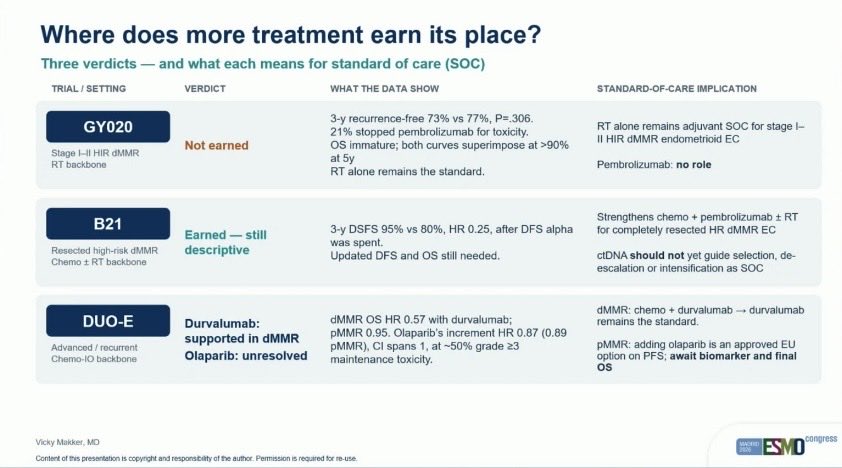
#DUO_E: stage III to IV or recurrent, first line. Three arms, all with chemo: chemo alone, chemo + durvalumab, or chemo + durvalumab followed by durvalumab + olaparib maintenance. Both regimens beat chemo on PFS. Survival tells a different story by MMR status. dMMR: durvalumab drives the benefit, OS HR 0.57. Olaparib adds nothing, PFS HR 0.97. pMMR, 80% of patients: durvalumab alone, OS HR 0.95. Olaparib adds modest PFS, HR 0.76, no survival benefit shown, and grade ≥3 AEs rise from 26.8% to 49.5%. Olaparib was never formally tested against durvalumab alone. That comparison is exploratory.
#KEYNOTE_B21: after surgery, stage III to IVA, or stage I to II serous, clear cell or carcinosarcoma. Chemo ± pembro. Negative overall. dMMR 3-yr DSFS 95% vs 80%, large but descriptive.
#NRG_GY020: stage I to II endometrioid dMMR, high-intermediate risk. Radiation ± pembro. Negative, 73% vs 77%. 21% stopped pembro for toxicity.
My read: after surgery, pembro helps where risk is high and adds little where cure is already likely. In pMMR, we keep adding drugs and buying PFS, not survival. Olaparib is not the partner for IO in endometrial cancer. In ovarian, PARP inhibition rides on homologous recombination deficiency. More on the mechanism in a separate post.
How I will practice: 1- dMMR, advanced or high risk: IO in first line. 2- dMMR, early stage: radiation alone. 3-pMMR: I discuss olaparib honestly, a few months of PFS for real toxicity.
Molecular profile first, trials early.
Where I am putting my effort: the
pMMR, with ADCs and selection by tumor biology.#gyncsm #ESMO26 @myESMO
Slides: Vicky Makker's discussion, ESMO 2026.
🔖 7 ❤️ 3 🔁 2 👁 358
Mali Barbi, MD MSc | Breast & Gyn Oncologist @DrBarbiOnc
What big news for our #ovariancancer patients!
Overall survival in #PROC has been hard to move. AURELIA improved PFS with bev but not OS. MIRASOL was the first phase 3 OS benefit, HR 0.67, and only in FRα-high.
#RAINFOL02 topline today: rina-S vs chemo, OS HR 0.43, PFS HR 0.29, no FRα selection. Press release only, no medians yet.
If the FDA label follows the ITT population, FRα IHC stops being the gate for an ADC in PROC.
The sequence changes too. For FRα-high patients, the choice becomes mirvetuximab (DM4) then rina-S (TOPO1), or the reverse. The analysis set includes post-mirvetuximab patients, so part of that answer is already in the data.
And once a TOPO1 ADC is standard in PROC, every TOPO1 ADC after it is a payload rechallenge. #gyncs
Genmab Announces Rinatabart Sesutecan (Rina-S®) Demonstrates Statistically Significant Improvement in Progression-Free Survival and Overall Survival in Patients with Platinum-Resistant Ovarian Cancer - https://t.co/s2tOOIt3vb
🔖 4 ❤️ 10 🔁 3 👁 1,407
cGxP Wire @cGxPWire
🎗️ Genmab Reports Positive Phase 3 Results for Rina-S in Ovarian Cancer
The company announces positive late-stage clinical findings for its investigational ovarian cancer treatment.
👉 https://t.co/xH9Rb3fZfQ
#Genmab #OvarianCancer #ClinicalTrials https://t.co/SuUsrA5BBE
🔖 0 ❤️ 0 🔁 0 👁 87

Business-News-Today.com @BNTBriefing
Rina-S Phase 3 success brings new hope for platinum-resistant ovarian cancer patients https://t.co/OvswNYGVnq #Genmab #RinaS #OvarianCancer #PlatinumResistantOvarianCancer #Phase3 #AntibodyDrugConjugates #Oncology #ClinicalTrials $GMAB
🔖 0 ❤️ 0 🔁 0 👁 109
Dr Swati Shah - MS DNB Surgical Oncology @cancer_clinix
Locally advanced cervical cancer: six weekly doses of carboplatin-paclitaxel, then standard chemoradiation.
INTERLACE, 5-year OS: 80% vs 72%, HR 0.60.
The cost: grade 3+ events 59% vs 48%.
A short, cheap regimen with a survival gain.
#cervicalcancer #TheLancet
🔖 0 ❤️ 0 🔁 0 👁 9
🧪 Newly Recruiting Trials
3 trials (1 phase II, 2 phase I) opened this week, testing TJ102, STRO-006 and misetionamide
Phase 1/2 · Phrontline Biopharma · TJ102 · California, Florida, New York, Pennsylvania, Tennessee, Texas +1 more · CT.gov ↗
Phase 1 · Sutro Biopharma, Inc. · STRO-006 · Florida, Massachusetts, Oklahoma, Texas, Virginia · CT.gov ↗
Phase 1 · Persevere Therapeutics Inc. · misetionamide · Illinois, Kansas, Massachusetts, Pennsylvania · CT.gov ↗
Open all 3 on the trials page →
Agent descriptions from the NCI Thesaurus.
Prepared by Rafael Santana-Davila, M.D. Questions or feedback? Just reply to this email.
Disclaimer: This digest is AI-generated. Content may contain errors -- always verify with original sources.
Know a colleague who would find this useful? Just forward them this email.
☕ Not funded by anyone — no sponsors, no pharma. Buy me a coffee if it's useful.